


Tracking Ovulation: A Clinical Guide to Identifying Your Fertile Window
Understanding when ovulation occurs — and recognising the physiological signs that precede it — is one of the most evidence-supported strategies available to couples trying to conceive. Here is what to look for, how to track it accurately, and how to time intercourse effectively. Lifestyle pieces such as Marie Claire’s tips on conceiving naturally still put a prenatal multivitamin, vitamin D and CoQ10 on the “keep your body ready” list — useful magazine context, not a clinic protocol.
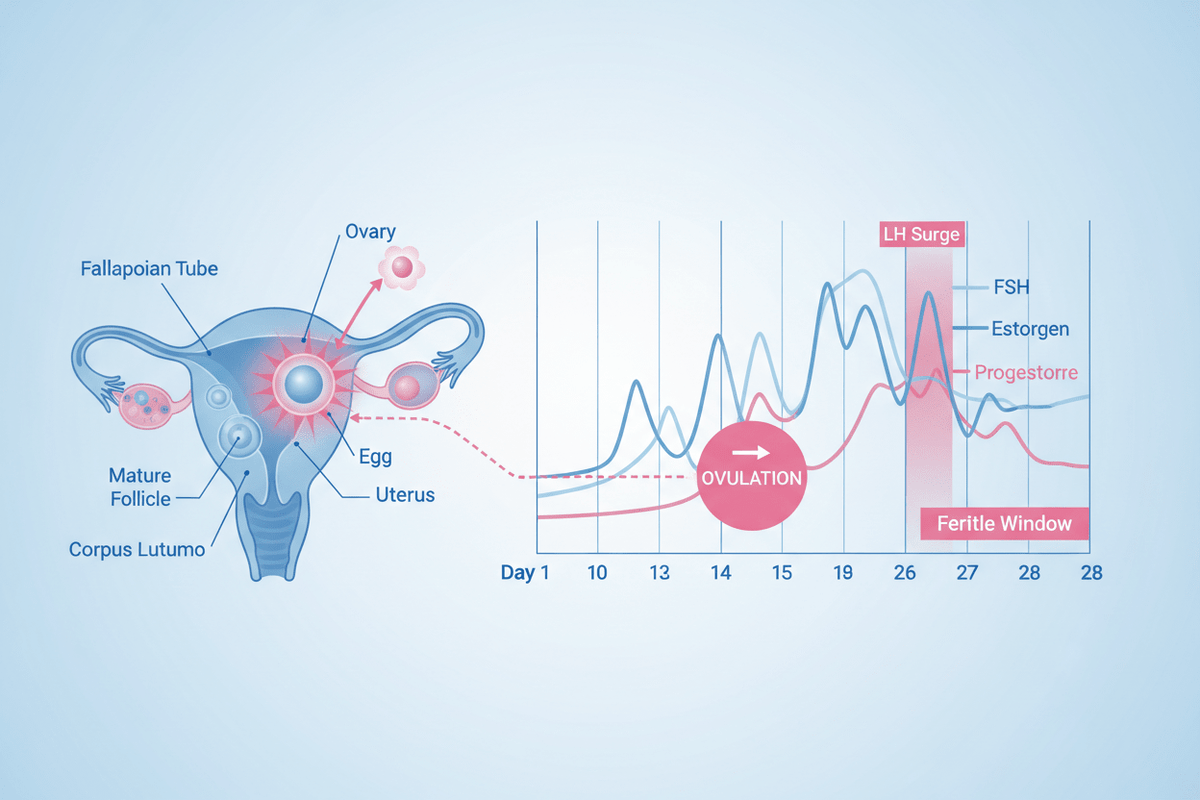
Ovulation — the release of a mature egg from the ovary — is the central event of the menstrual cycle and the prerequisite for natural conception. Despite its biological significance, ovulation is frequently misunderstood or poorly timed, which is among the most common and correctable reasons couples take longer than necessary to conceive.
Ovulation typically occurs once per cycle, approximately at the midpoint of a regular 28-day cycle — though individual variation means cycles of 21 to 35 days are within the normal range. Once released, the egg remains viable for just 12–24 hours. Sperm, by contrast, can survive within the female reproductive tract for up to five days. This asymmetry defines the fertile window.
Couples who accurately identify and time intercourse around ovulation have a 20–30% chance of conception per cycle — compared to approximately 5–10% for those timing intercourse without cycle awareness. Ovulation tracking is among the highest-impact, lowest-cost fertility interventions available.
Clinical Signs of Ovulation to Monitor
The body produces measurable physiological changes in the days surrounding ovulation. Monitoring multiple signs simultaneously — rather than relying on any single indicator — provides the most accurate picture of the fertile window.
Cervical Mucus Changes
As oestrogen rises in the days before ovulation, cervical mucus transitions from thick and opaque to clear, slippery, and elastic — often described as resembling raw egg white. This fertile-quality mucus creates a permissive environment for sperm transport, significantly extending effective sperm survival. Monitor daily and note consistency and volume.
Most reliable daily indicatorBasal Body Temperature (BBT) Shift
Progesterone released after ovulation causes a sustained rise in resting body temperature of approximately 0.2–0.5°C. BBT must be measured immediately upon waking, before any movement, using a sensitive thermometer. The rise confirms ovulation has occurred — making BBT a retrospective indicator most useful for identifying patterns across multiple cycles rather than predicting the current cycle's ovulation in real time.
Confirms ovulation retrospectivelyMittelschmerz (Ovulation Pain)
Some women experience a unilateral ache or twinge in the lower abdomen — typically on the side of the ovulating ovary — lasting from minutes to several hours. Caused by the distension and rupture of the dominant follicle, mittelschmerz is a clinically recognised phenomenon that provides a useful same-day ovulation signal for those who experience it consistently.
Present in a subset of womenLH Surge Detection
The luteinising hormone (LH) surge precedes ovulation by 24–36 hours and can be detected via urine-based ovulation predictor kits (OPKs). A positive result indicates the fertile window is now open and intercourse should be prioritised within the following 24–48 hours. This is the most predictively accurate tool available without clinical monitoring.
Most predictively accurate methodCervical Position Changes
Around ovulation, the cervix rises higher in the vaginal canal, softens in texture, and the cervical os (opening) widens slightly. For women who learn to monitor cervical position, this provides a free, real-time indicator of fertility status that complements other tracking methods.
Secondary Indicators
Increased libido, mild breast sensitivity, and mid-cycle spotting (caused by the brief oestrogen dip at ovulation) are secondary signs that some women notice consistently. While not reliable in isolation, they contribute useful context when interpreted alongside primary indicators.
Methods for Accurate Ovulation Tracking
Ovulation Predictor Kits (OPKs)
Urine-based LH tests that detect the hormonal surge preceding ovulation by 24–36 hours. Begin testing several days before expected ovulation and test at the same time each day. A positive line indicates peak fertility — prioritise intercourse that day and the next.
Fertility Tracking Apps
Apps including Flo, Natural Cycles, and Ovia use cycle history, symptom input, and — where integrated — wearable data to generate predictive fertile window estimates. Accuracy improves substantially over 3–6 cycles of consistent data input.
Wearable Devices
Devices such as Ava, Tempdrop, and compatible rings (including Oura) track multiple physiological variables — skin temperature, resting heart rate, respiratory rate, and sleep — overnight to generate fertile window predictions without active daily tracking.
Fertility Awareness Method (FAM)
The gold-standard observational approach — combining daily BBT charting, cervical mucus monitoring, and cycle calendar tracking. Requires consistent practice across several cycles to establish reliable personal baselines, but provides the most comprehensive picture of individual cycle patterns.
No single method is optimal in isolation. Combining OPK testing with cervical mucus observation provides the most actionable and accurate real-time fertile window identification for the majority of women. Add BBT charting for pattern recognition across cycles.
Evidence-Based Guidance on Timing Intercourse
Additional Factors That Influence Conception Probability
Intercourse Frequency During the Fertile Window
Every 24–48 hours during the fertile window maintains both sperm quality and availability. Daily intercourse is not associated with meaningful sperm count reduction in men with normal parameters, but every-other-day is the evidence-supported recommendation for most couples.
Post-Coital Position
Remaining supine for 10–15 minutes following intercourse may assist sperm transit toward the cervix, though evidence for specific positions improving conception rates is limited. Avoiding immediate physical activity is a reasonable and low-effort practice.
Lubricant Selection
Many commercially available lubricants are spermicidal or reduce sperm motility. If lubricant is needed during the fertile window, choose one specifically formulated to be sperm-compatible — such as Pre-Seed or conceive-plus — or use natural alternatives such as canola oil.
Lifestyle Optimisation
Maintaining a healthy BMI, ensuring adequate intake of folate, zinc, and iron, moderating alcohol, avoiding smoking, and managing chronic stress all have documented positive effects on cycle regularity and conception probability. These are not supplementary — they are foundational.
When to Seek Clinical Advice
If conception has not occurred after 12 months of well-timed intercourse (or 6 months for women over 35), clinical investigation is appropriate. Ovulation tracking data collected over this period provides genuinely useful information for a fertility specialist to interpret.
How Her Fertility fits
Tracking tells you timing. It does not replace 400 µg folate or a GP if cycles are absent. Her Fertility is the preconception formula (5-MTHF 400 µg, CoQ10 300 mg, NAC 400 mg, zinc 20 mg) for the same months you are tracking — not an ovulation drug.
Frequently asked questions
What is the most reliable way to know you have ovulated?
A positive ovulation predictor kit (LH surge) shows ovulation is likely imminent, not that it has already happened. A mid-luteal progesterone blood test arranged by a clinician is stronger evidence that ovulation occurred. Basal body temperature rises after ovulation, so it is better for confirming patterns than for timing the same day.
How many days before ovulation should couples try?
Sperm can survive several days in fertile mucus. Aiming for intercourse in the days leading up to the expected ovulation day (not only on the day itself) usually covers the fertile window more realistically than a single timed attempt.
Can supplements replace ovulation tracking?
No. Nutrient formulas support general nutritional status; they do not detect LH surges or replace cycle tracking, ultrasound, or clinical tests.
Free 90-day prep checklist (ungated PDF).
Read our complete guide: Male & female fertility: the complete UK guide



Leave a comment
All comments are moderated before being published.
This site is protected by hCaptcha and the hCaptcha Privacy Policy and Terms of Service apply.